
BRAUNSCHWEIG, Germany — 12 November 2026 — QUDORA, a German-based developer of ion-trap quantum computers, and its partners have launched QUANDA (Quantum Anomaly Detection & Analysis), a three-year research project that will integrate QUDORA’s trapped-ion quantum computers into high-performance computing (HPC) environments to test quantum machine learning on real-world anomaly detection tasks in the energy sector.
Funded by Germany’s Federal Ministry of Research, Technology and Space (BMFTR) under its “Development of Digital Technologies” program, QUANDA connects quantum hardware, computing infrastructure and energy-sector applications. The project will develop an automated pipeline for running hybrid quantum algorithms and test it through three energy-sector use cases.
Working with GWDG, the joint IT and computing center of the University of Göttingen and the Max Planck Society, QUDORA will develop the integration between its quantum systems and HPC infrastructure. The pipeline will cover job submission, transpilation and compilation, and execution on quantum hardware. It is intended to give companies and research institutions standardized access to trapped-ion quantum computing without requiring them to manage the underlying hardware.
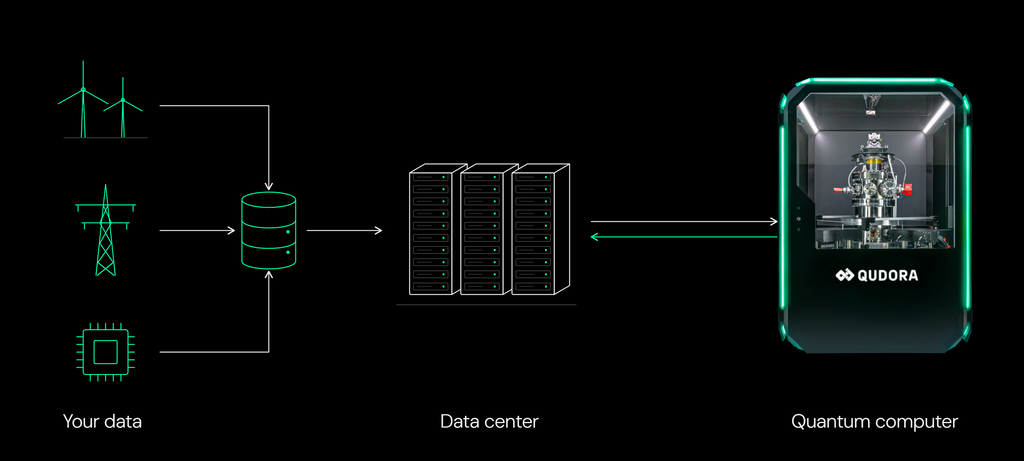
Many quantum algorithms depend on repeated exchanges between classical and quantum processors. Classical computers prepare inputs, manage calculations and process measurement results, while quantum processors execute selected parts of the computation. For quantum machine learning, this can involve repeated circuit executions within a classical training or optimization process.
Making that workflow practical requires software that can translate algorithms into operations supported by the hardware and coordinated access to computing resources. QUANDA addresses this integration layer by developing an automated execution pipeline. Reducing the manual work needed to move between classical and quantum systems will help researchers run experiments within a consistent workflow and investigate how quantum routines can contribute to a broader computation.
“Unlocking the full potential of future quantum applications requires bringing together the strengths of high-performance computing (HPC) and quantum computing. Through the QUANDA project, we are working to develop and optimize hybrid computing workflows that combine these complementary technologies, paving the way for advances in quantum machine learning and its practical applications.”
Dr. Daniel Borcherding
Head of Quantum Software, QUDORA
Anomaly detection identifies patterns that depart from expected behavior. In the energy sector, these can include unusual electricity consumption, changes in equipment sensor readings or unexpected behavior in generation and distribution systems. Such deviations may indicate a developing fault or an operational change that warrants investigation.
QUANDA will use real-world energy-sector use cases to test quantum-based anomaly detection through the hybrid pipeline. These application tests connect the infrastructure work to practical questions about how quantum machine learning can be implemented and evaluated using real-world problems.
The consortium brings together QUDORA, Deggendorf Institute of Technology, Leibniz University Hannover’s Institute of Information Processing and Institute for Theoretical Physics, GWDG, UBT Future Energy Lab Wunsiedel GmbH and ZukunftsEnergie Nordostbayern GmbH (ZENOB).
About QUDORA
Founded in 2021 and headquartered in Braunschweig, Germany, QUDORA develops full-stack trapped-ion quantum computers and standalone quantum processors. Its proprietary Near Field Quantum Control (NFQC®) technology uses integrated microwave electronics to control trapped-ion qubits, combining precise quantum operations with an architecture compatible with standard semiconductor manufacturing processes. QUDORA provides systems for on-premises installation and works with partners to make its technology accessible through cloud platforms. Through QUDORA Japan K.K., the company is expanding its partnerships and commercial presence across the Asia-Pacific region.