
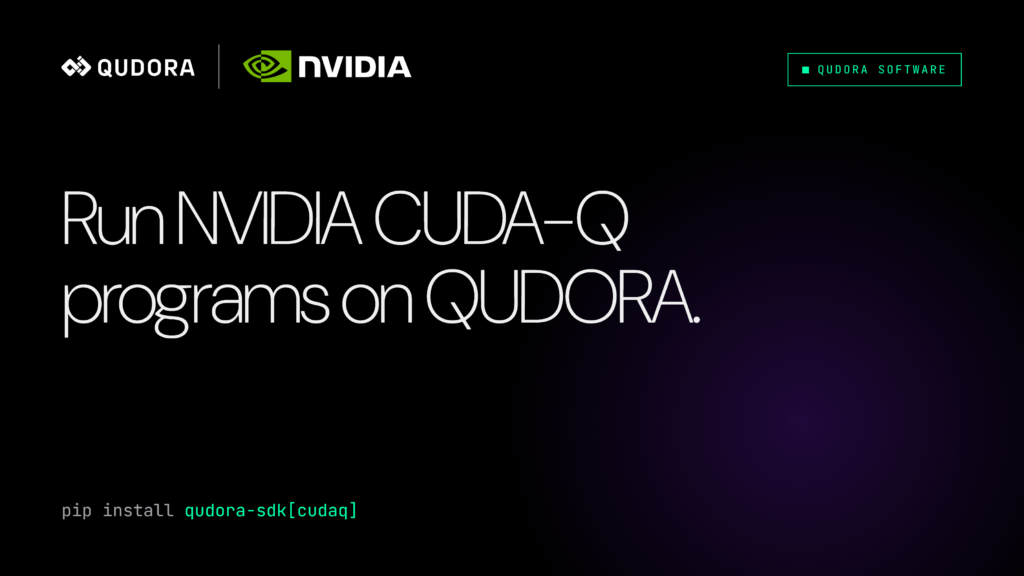
Developers can now test NVIDIA CUDA-Q programs on QUDORA’s Qamelion emulator and prepare for execution on its upcoming trapped-ion quantum computers
BRAUNSCHWEIG, Germany — 16 November 2026 — QUDORA Technologies, a German-based developer of ion-trap quantum computers, has integrated NVIDIA CUDA-Q into its software development kit, enabling developers to write hybrid quantum-classical programs and run them on Qamelion, QUDORA’s quantum emulator with adaptive noise modeling. The integration gives CUDA-Q users access to an environment for developing and testing algorithms ahead of the availability of QUDORA’s systems.
Hybrid quantum-classical computing brings quantum operations and classical processing into a coordinated workflow. In many algorithms, classical processing prepares inputs, updates parameters or interprets results from a quantum calculation. More adaptive programs also use measurements taken during a circuit to decide which quantum operations to perform next.
“The future of quantum computing is hybrid, combining quantum and classical computing to solve complex problems more effectively,” said Dr. Daniel Borcherding, head of Quantum Software at QUDORA. “NVIDIA CUDA-Q provides developers with a natural way to build these applications, while QUDORA’s platform gives them an environment to test those programs today and prepare for execution on our trapped-ion hardware.”
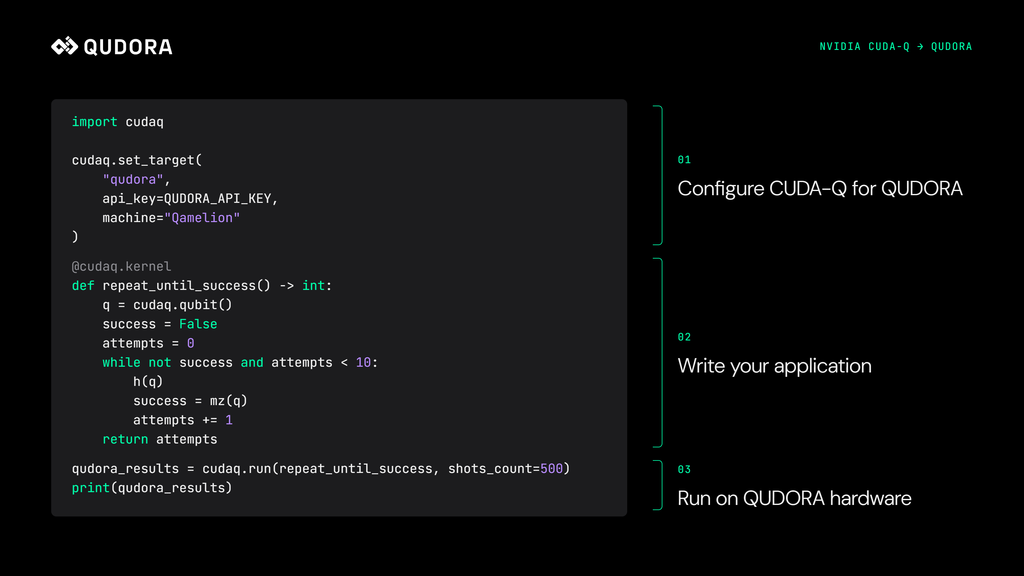
A quantum program’s behavior depends on both its instructions and the system that executes them. Noise in quantum operations and measurements can affect the results, making emulation an important part of algorithm development before testing on a physical processor.
Qamelion models QUDORA’s upcoming trapped-ion hardware under realistic noise conditions. Through the integration, CUDA-Q users can test supported programs in that environment, examine their measurement results and investigate how noise affects their behavior.
For developers, the benefit is continuity between software development and preparation for hardware execution. They can begin implementing and testing programs now, using the same programming platform intended for later access to QUDORA’s processors. The planned change of target machine simplifies that transition at the software level; performance on physical hardware will still need to be evaluated.
The integration is relevant to quantum algorithm researchers, engineers developing hybrid computing workflows and industry teams investigating quantum applications. It provides a practical starting point for testing algorithm behavior and refining implementations as QUDORA develops its hardware.
Availability
The CUDA-Q integration is available now through the QUDORA SDK. Developers can install CUDA-Q support using the command pip install qudora-sdk[cudaq] and connect to QUDORA Cloud with an API token. Installation instructions and programming examples are available at pypi.org/project/qudora-sdk. Developers can register for a free trial of Qamelion at cloud.qudora.com.
About QUDORA
Founded in 2021 and headquartered in Braunschweig, Germany, QUDORA develops full-stack trapped-ion quantum computers and standalone quantum processors. Its proprietary Near Field Quantum Control (NFQC®) technology uses integrated microwave electronics to control trapped-ion qubits, combining precise quantum operations with an architecture compatible with standard semiconductor manufacturing processes. QUDORA provides systems for on-premises installation and works with partners to make its technology accessible through cloud platforms. Through QUDORA Japan K.K., the company is expanding its partnerships and commercial presence across the Asia-Pacific region.