
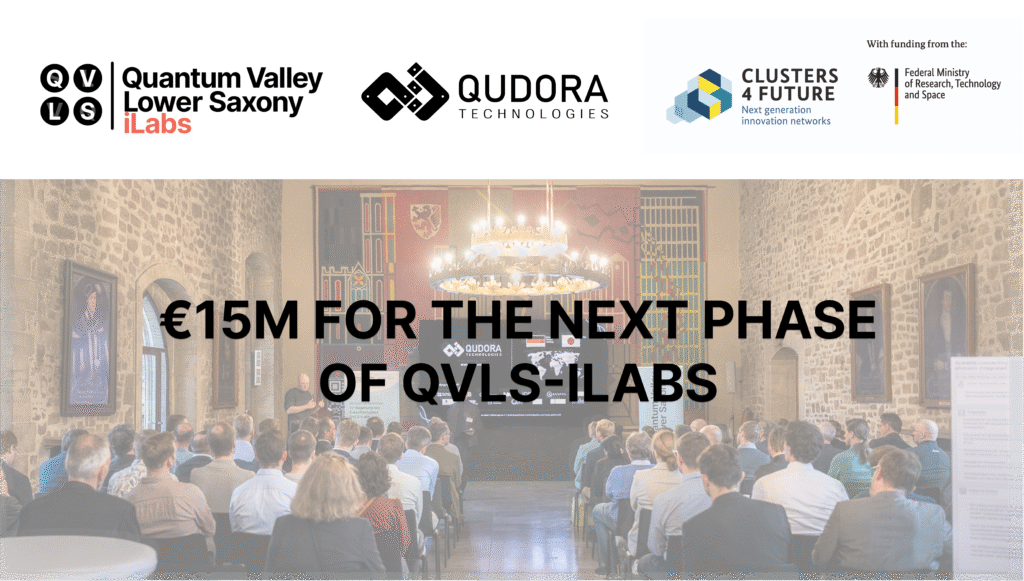
Braunschweig, Germany – QUDORA Technologies welcomes the continuation of the QVLS-iLabs future cluster, which has been approved for a second funding phase with €15 million over the next three years. As an industry partner within the cluster, QUDORA will continue contributing to the development of application-oriented quantum technologies in the Hannover–Braunschweig region.
The funding is provided within the Federal Government’s Clusters4Future initiative by the Bundesministerium für Forschung, Technologie und Raumfahrt (BMFTR). QVLS-iLabs is one of very few clusters with an exclusive focus on quantum technologies, emphasizing the strategic relevance of quantum computing and quantum metrology for Germany’s technological sovereignty and industrial future.
Following a competitive selection process in the first funding round with 117 applications, QVLS-iLabs was now approved to continue its work in the second funding round with 25 partners from research institutions, industry, and startups. The cluster focuses on trapped-ion quantum computing and quantum metrology applications, developing robust, application-ready quantum components for industrial use.
Research-to-Market Integration
For QUDORA Technologies, the cluster’s continuation validates the effectiveness of close research-industry collaboration. The company’s newest model of trapped-ion quantum computer, developed and built in Braunschweig, demonstrates how this environment enables the translation of cutting-edge research into competitive, market-ready systems. Designed for both seamless on-premise integration with existing HPC infrastructure and standalone use, QUDORA’s systems are already bridging the gap between quantum research and industrial deployment.
Prof. Dr. Christian Ospelkaus, QVLS-iLabs spokesperson, professor at the Physikalisch-Technische Bundesanstalt (PTB) and Leibniz Universität Hannover, and QUDORA co-founder, emphasized that the first phase’s successes provide strong momentum for establishing sustainable transfer structures toward market deployment.
Concrete Industrial Impact
The first funding phase delivered tangible results beyond academic research, including open-source software for quantum experiments used by research groups worldwide, multiple patents, and industrial use cases such as quantum sensors for battery manufacturing optimization. These outcomes demonstrate how quantum technologies developed within the cluster are becoming usable tools for industry.
The cluster’s infrastructure includes a 350-square-meter deep-tech laboratory in Braunschweig’s Rolleiwerke, providing space for quantum startups and industrial development. The newly founded QVLS Innovation GmbH now manages the cluster, ensuring professional structures for long-term technology transfer.
The cluster’s relevance for regional development was also underscored by Braunschweig’s Mayor, Dr. Thorsten Kornblum, who lately visited QUDORA’s new headquarters to view the company’s newly built quantum computer: “The federal government’s continued funding for the QVLS-iLabs future cluster is great news for Braunschweig and the entire region. It is also confirmation of the outstanding work of our strong partners in the QVLS consortium, above all the Physikalisch-Technische Bundesanstalt and TU Braunschweig. The economic potential of quantum technologies for our medium-sized businesses and innovative startups is enormous.”
QUDORA is grateful for the continued support of the Bundesministerium für Forschung, Technologie und Raumfahrt (BMFTR) and the commitment of all partners involved and looks forward to contributing to the second phase of QVLS-iLabs and advancing the transfer of quantum technologies into industrial and societal applications.
About QVLS-iLabs
The QVLS-iLabs future cluster is a regional innovation network with a base in Lower Saxony. In the cluster’s own deep-tech laboratory with an area of 350 square meters in Braunschweig’s Rolleiwerke, quantum startups can take their first steps and write success stories: for example, the Braunschweig quantum computer from QUDORA Technologies GmbH, which calculates more efficiently than the competition from Google and IBM. Support is also provided by the newly founded QVLS Innovation GmbH, which will professionally operate the cluster management in the future, take over the operation of the deep-tech laboratories in the Rolleiwerke, and drive further QT transfer projects in the region.
qvls.de/de/ilabs
About QVLS
Quantum Valley Lower Saxony brings together Lower Saxony’s quantum expertise from science, industry, and politics. The non-profit association QVLS e.V. unites a broad consortium of research institutions, industry partners, industry associations, and economic development agencies, and covers the entire innovation chain from basic research to commercial exploitation.
qvls.de
About the Future Clusters Initiative
The Future Clusters Initiative (Clusters4Future) is a flagship funding program of the Federal Ministry for Research, Technology and Space Travel. Its goal is to make research findings usable more quickly and bring them into application.
clusters4future.de
About QUDORA
Founded in 2021, QUDORA is a leading full-stack system integrator of trapped-ion quantum computers based in Germany. The company’s proprietary Near-Field Quantum Control (NFQC) technology brings together ultra precise qubit control with very long coherence times significantly improving the performance per qubit. QUDORA’s QC systems are designed for seamless integration with existing industrial infrastructure, including on-premise deployments for HPC centers. With operations in Braunschweig and Hamburg, QUDORA is making quantum computing accessible to a broader range of applications and industries.
qudora.com
Media Contact
QUDORA Technologies GmbH
Anastasiia Sidorova
Communications Manager
press@qudora.com